

PREORDER - Divided Loyalty: Uneven Paths to Freedom in South Carolina during the Revolutionary War
PREORDER - Divided Loyalty: Uneven Paths to Freedom in South Carolina during the Revolutionary War
Type
BookSubtotal
$34.95Couldn't load pickup availability
Estimated deliver 5-7 days
Description
AVAILABLE FOR PREORDER - ORDERS TO BE SHIPPED BY END OF NOVEMBER.
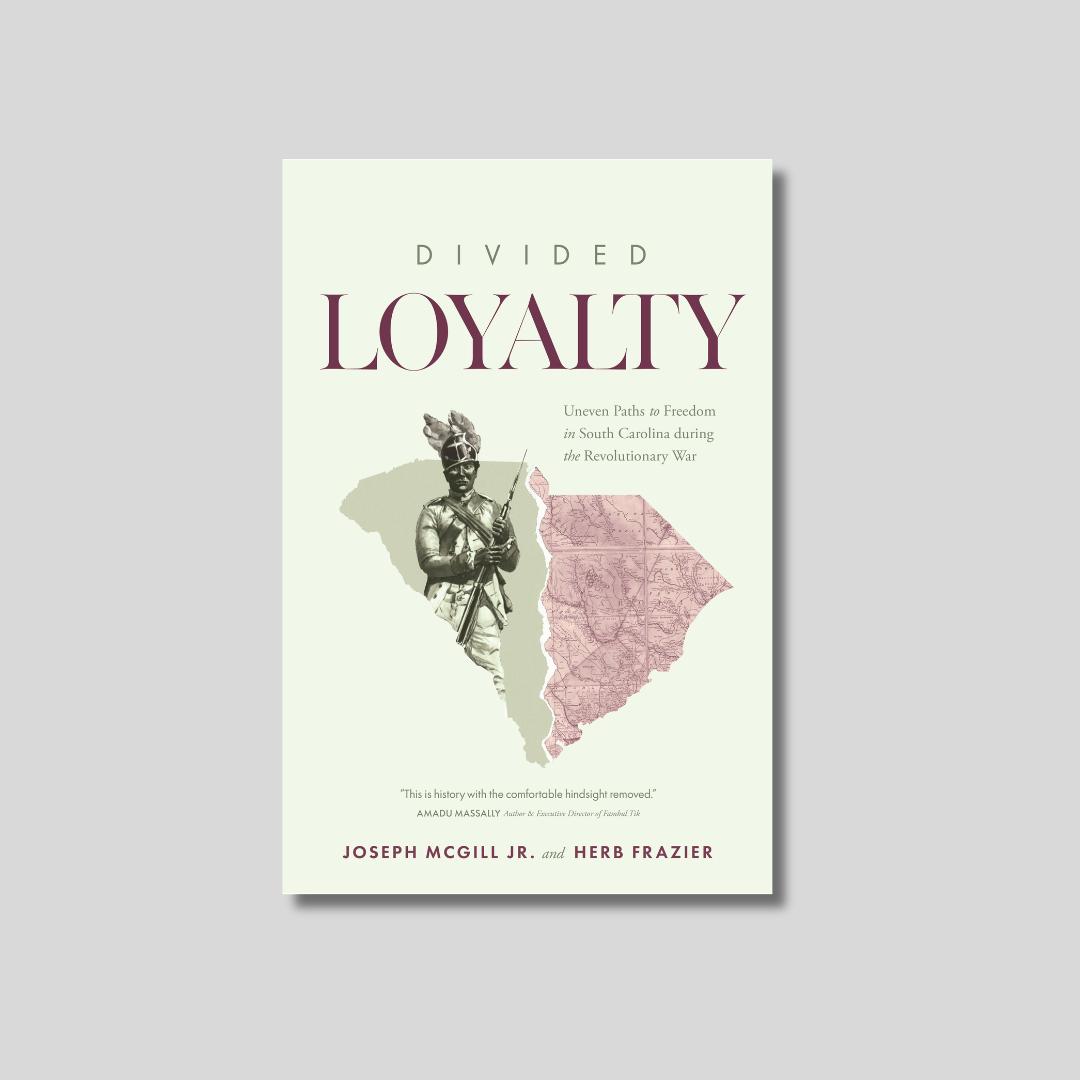
Divided Loyalty reveals a Revolutionary War history too often left untold. Joseph McGill Jr. and Herb Frazier trace the experiences of Black patriots, Black loyalists, enslaved people seeking freedom, and Indigenous people navigating a conflict that divided South Carolina and reshaped a nation.
Drawing on archival research, historic battlefields, descendants’ stories, and McGill’s travels with the Slave Dwelling Project, the authors show that the Revolution’s promise of liberty did not reach everyone equally. Some found freedom. Others remained enslaved or were re-enslaved. Native nations faced choices of their own as the Catawba, Cherokee, and others weighed alliances, survival, and the future of their lands.
Centered on the people conventional Revolutionary histories have too often overlooked, Divided Loyalty offers a fuller and more complicated story of how American independence was won—and who was still waiting for freedom when the fighting ended.
ABOUT THE AUTHORS
Herb Frazier is a senior editor for the Charleston City Paper and the former public relations director at Magnolia Plantation and Gardens in Charleston. Named “Journalist of the Year” in 1990 by the South Carolina Press Association, Frazier has edited and reported for five daily newspapers throughout his career, including his hometown paper, The Post and Courier.
He is the author of Behind God’s Back: Gullah Memories and co-author of We Are Charleston: Tragedy and Triumph at Mother Emanuel with Marjory Wentworth and Dr. Bernard Powers Jr. Frazier is also co-author of Sleeping with the Ancestors: How I Followed the Footprints of Slavery, written in collaboration with Joseph McGill Jr., founder of the Slave Dwelling Project.
Frazier’s forthcoming book, Crossing the Sea on a Sacred Song, tells the story of a West African funeral song and its ties to a Georgia family and a Mende woman in Sierra Leone.
Joseph McGill Jr. is a public historian, preservationist, author, and founder and executive director of the Slave Dwelling Project, a nationally recognized nonprofit organization dedicated to preserving extant slave dwellings and centering the stories of the people who were enslaved in them.
Since founding the Slave Dwelling Project in 2010, McGill has spent hundreds of nights in former slave dwellings across the United States. Through overnight stays, living-history programs, public conversations, and educational initiatives, he challenges traditional interpretations of American history and brings together descendants, historians, preservationists, educators, students, and communities at the places where slavery occurred.
A veteran of the United States Air Force, McGill previously served as a ranger with the National Park Service and as a field officer with the National Trust for Historic Preservation. He is also a longtime Civil War reenactor whose interpretation of the United States Colored Troops has helped illuminate the experiences and contributions of African American soldiers during the Civil War.
McGill is the coauthor, with journalist Herb Frazier, of Sleeping with the Ancestors: How I Followed the Footprints of Slavery, which chronicles his journey sleeping in slave dwellings and his efforts to ensure that these endangered spaces—and the people whose lives they represent—are not erased from the American landscape.
His preservation and public-history work has taken him to historic sites and communities throughout the country and has been featured by national and international media, including PBS, NPR, and the Smithsonian Channel. Through the Slave Dwelling Project, McGill continues to advocate for a more complete telling of American history—one that recognizes the lives, labor, families, resistance, resilience, and humanity of enslaved people as central to the American story.
At the heart of McGill’s work is a simple conviction: the places where enslaved people lived matter, and preserving those places creates opportunities to tell stories that generations of Americans were never taught.
Through preservation, education, living history, and conversation, Joseph McGill Jr. continues his mission of changing the narrative—one slave dwelling at a time.